

What It Is, What It Means & How to Fix It
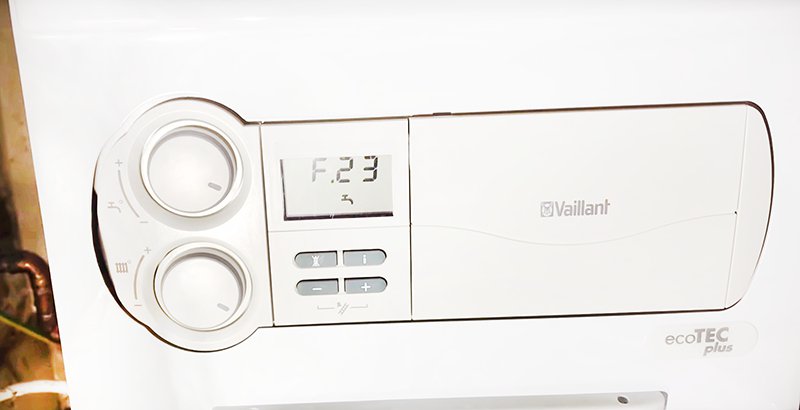
If your Vaillant boiler has suddenly stopped working and your display is showing the Vaillant F23 fault code, you’re not alone. This is one of the more common fault codes found on Vaillant ecoTEC models, and it typically appears when there’s a problem with water circulation or temperature imbalance inside the boiler system. While it can sometimes be resolved with simple checks, the underlying causes can also be linked to serious issues that require a Gas Safe registered engineer.
In this guide, we’ll break down exactly what the Vaillant F23 fault code is, why it occurs, the most common causes behind it, and how it can be fixed safely. We’ll also explain what homeowners should (and should not) try to do themselves.
What Is the Vaillant F23 Fault Code?
The Vaillant F23 fault code is essentially a safety message from your boiler. It appears when the boiler detects a temperature difference between the flow and return pipes that is much greater than it should be. In other words, water leaving the boiler is significantly hotter than the water returning back to it and that imbalance can cause overheating, damage, or even system failure.
Vaillant boilers are designed to shut down automatically when this happens so they can protect themselves. The F23 error tells you that the internal circulation of water isn’t working correctly.
What Does the Vaillant F23 Fault Code Mean?
The F23 code means one thing: There is poor or insufficient water circulation inside the boiler or heating system.
That lack of circulation is normally caused by:
Low system water pressure
Air trapped in the system
A partially blocked or sludged heating circuit
A failing pump
Issues with the diverter valve
Blocked or sticking motorised components
Temperature sensor faults
Because the boiler relies on steady and consistent circulation to regulate temperature, any disruption triggers the Vaillant F23 fault code. It’s a warning sign that something isn’t quite right and it shouldn’t be ignored.
Why Does the Vaillant F23 Fault Code Show?
Below are the most common causes of this fault code, ranging from simple issues to more serious faults that need professional attention.
1. Low Water Pressure
Your boiler needs enough water in the system to circulate heat properly. If the pressure drops too low, circulation suffers and the boiler overheats, causing the F23 code.
Typical signs:
Pressure gauge under 1 bar
Radiators failing to heat fully
Gurgling sounds in the system
2. Airlocks in the System
Air can get trapped in radiators or pipework, stopping water from flowing smoothly. When circulation becomes inconsistent, the boiler reacts with the F23 fault code.
3. A Blocked or Sludged Heating System
Over time, heating systems build up rust, debris, and sludge. If your radiators are cold at the bottom or heat unevenly, sludge may be restricting circulation.
This is a very common reason for the Vaillant F23 fault code.
4. Pump Problems
The pump is responsible for pushing water around the system. If it’s failing, blocked, or set incorrectly, circulation becomes too slow and uneven.
A faulty pump is one of the more serious causes of the F23 error.
5. Diverter Valve Issues
On combination boilers, the diverter valve directs water to either the radiators or taps. If it sticks, jams, or fails internally, water may not move through the system as it should.
6. Faulty Temperature Sensors
If the flow or return temperature sensors (NTCs) are faulty, the boiler may believe the temperature difference is extreme even if the system is working normally.
How to Fix the Vaillant F23 Fault Code
Before attempting anything, it’s crucial to understand that gas boilers are dangerous appliances. Incorrect handling can cause gas leaks, carbon monoxide exposure, electrical hazards, or water damage.
You should never open the boiler casing yourself unless you are Gas Safe registered.
However, there are a few simple checks you can carry out safely. After that, a professional engineer should diagnose and repair the issue.
1. Check Your Boiler Pressure
Look at the pressure gauge. A healthy system normally sits between 1.0 and 1.5 bar.
If it’s below 1 bar, the boiler may have locked out due to low pressure.
You can top up the pressure using the filling loop (if you know how), but do so carefully.
If the pressure keeps dropping repeatedly, avoid topping it up again and again this is usually a sign of a leak, and you’ll need an engineer immediately.
2. Bleed Your Radiators
Airlocks can cause circulation problems.
If some radiators feel warm at the bottom but cold at the top, bleeding them can help. Make sure the boiler is turned off first.
After bleeding, check the pressure again you may need to top it up slightly.
3. Reset the Boiler
Sometimes the Vaillant F23 fault code will clear after a reset, especially if the boiler temporarily overheated.
However, if the fault returns, there is an underlying problem.
4. Call a Gas Safe Engineer for Deeper Issues
The following issues can only be fixed by a professional:
Pump failure or incorrect pump speed
Diverter valve faults
Blocked heat exchanger
Sensor faults
Sludge build-up requiring power flushing
Electrical or PCB faults
Trying to fix these yourself is dangerous and could invalidate your warranty.
Is the Vaillant F23 Fault Code Dangerous?
The code itself is a protective mechanism but the cause can be dangerous if ignored.
For example:
Pump failures can lead to overheating
Blocked systems can damage the heat exchanger
Internal leaks may cause short-circuits
Pressure issues can cause frequent lockouts
Always take this fault seriously.
Need Help Fixing Your Vaillant F23 Fault Code?
If your boiler is showing the Vaillant F23 fault code, the safest and most reliable solution is to call a Gas Safe boiler engineer. While some simple checks can be done at home, most causes of the F23 error involve internal components and working inside a gas boiler without certification is both dangerous and illegal.
A professional engineer can:
Diagnose the root cause
Test the pump, sensors, and valves
Flush the system if needed
Repair or replace faulty parts
Reset the boiler safely
Don’t take risks with gas appliances. Get the issue fixed properly and restore reliable heating and hot water.
Get Your Vaillant F23 Fault Fixed Safely Today
Don’t risk your safety or damage your boiler if your Vaillant is showing the F23 fault code, contact a Gas Safe registered engineer today to diagnose and fix the problem quickly and safely.